
WHEN WINNING STOPS FEELING LIKE WINNING
The Hidden Emotional Cost of Championship-Level Leadership
By Brian Phelps | Transformation Growth
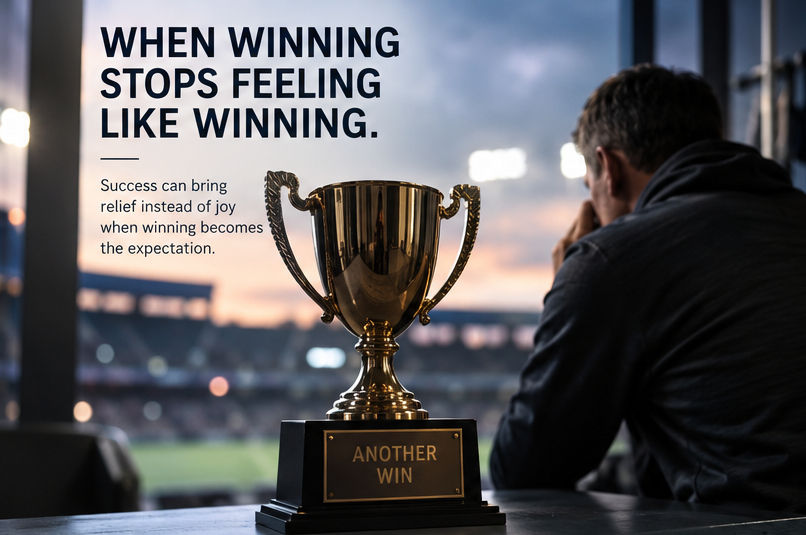
There is a side of leadership that rarely gets talked about. It is not the pressure of losing, the fear of failure, or even the challenge of building a successful business. It is something that happens after you have achieved a certain level of success. Something that can quietly steal the joy, excitement, and personal satisfaction from the very thing you have worked so hard to build.
It happens when winning becomes the expectation rather than the exception.
Think about a championship-level football team. When the team is struggling, every victory is celebrated. Players embrace, coaches smile, fans cheer, and the entire organization feels the excitement of moving one step closer to something meaningful. Each victory represents progress. Each victory builds confidence. Each victory gives everyone a reason to believe that something special is happening.
But something changes when that same team becomes a championship contender year after year. Suddenly, winning is no longer enough. The team is expected to win. The players are expected to perform at the highest level every single week. The coaches are expected to make the right decisions. The fans expect another championship, and anything less is viewed as a disappointment.
A victory that once brought excitement now brings something entirely different. Relief.
Relief that you didn’t lose. Relief that you didn’t disappoint anyone. Relief that you protected the reputation you worked so hard to build. Relief that you survived another week of expectations.
And before you even have a chance to enjoy that victory, the conversation has already shifted to the next game. What are we going to do next week? How are we going to keep this momentum going? What happens if we don’t win again?
The celebration gets shorter. The expectations get higher. The pressure never seems to go away. And somewhere along the way, winning stops feeling like winning.
For many business owners, CEOs, executives, and organizational leaders, this is not just a sports analogy. It is their everyday reality.
------------------------------------------------------------------------
The success trap nobody warned you about
When you first started your business or stepped into a leadership position, you probably had a very different relationship with success. You remember the excitement of landing your first major customer. The satisfaction of making payroll without worrying about whether there would be enough money in the bank. The pride you felt when your team accomplished something you weren’t sure was possible.
Maybe it was your first profitable month, your first million dollars in revenue, your first major expansion, or the moment you realized that the business you had dreamed about was becoming something real. Those moments mattered. You celebrated them because they represented progress. They reminded you why you started. They gave you the energy and confidence to keep moving forward, even when the challenges seemed overwhelming.
But as your business grew, so did the expectations. Your employees began depending on you for their financial security. Your customers expected consistent quality and service. Your investors, board members, business partners, and family developed expectations about what your continued success should look like. And perhaps the greatest expectations of all came from the person looking back at you in the mirror.
You began expecting more from yourself. The revenue number that once seemed impossible became the minimum acceptable performance. The profit margin you once celebrated became the baseline for next year’s budget. The customer you worked so hard to earn became another account you couldn’t afford to lose.
You started measuring success against your previous success rather than against the journey you were on. And without realizing it, you may have created a business where the definition of winning keeps moving further away.
Yesterday’s extraordinary performance becomes today’s minimum expectation.
You could be leading the most successful organization you have ever led, generating more revenue than ever before, creating more opportunities for your employees, and delivering more value to your customers. Yet emotionally, you might feel less successful than you did when your business was half its current size. Not because you have accomplished less. But because you have stopped allowing yourself to experience the satisfaction of what you have accomplished.
------------------------------------------------------------------------
When every victory feels like another obligation
I believe one of the most emotionally exhausting aspects of leadership is the feeling that every accomplishment immediately creates another obligation. You finish a successful quarter, and the conversation turns to the next quarter. You exceed your annual revenue target, and the following year’s target is increased. You successfully complete a major project, and another project is already waiting for your attention.
There is nothing inherently wrong with growth, ambition, or setting higher standards. Those are often essential ingredients of a successful organization. The problem begins when there is no longer any emotional space between achieving a goal and being held accountable for the next one.
Imagine running a marathon. You spend months preparing. You sacrifice your time, push through exhaustion, overcome injuries, and finally cross the finish line. But instead of someone congratulating you, handing you a medal, and allowing you to appreciate what you just accomplished, someone immediately points toward another starting line: “Great job. Now let’s see if you can do it again. Only faster this time.” You haven’t even caught your breath.
That is what leadership can begin to feel like when success becomes an endless series of escalating expectations. The problem isn’t that you don’t want to keep winning. The problem is that you never get to feel like you have won. And eventually, that can take a significant emotional and motivational toll.
You may begin to notice that the excitement you once felt about your business has been replaced by a constant sense of responsibility. You might find yourself worrying about the next challenge even while your team is celebrating the one you just overcame. You may even catch yourself thinking something you never imagined you would think when you first started: “I just want to get through this.”
Not because you have lost your passion for your business. But because the pressure of maintaining success has begun to overshadow the enjoyment of creating it.
------------------------------------------------------------------------
The loneliness of being the person everyone expects to win

The higher you rise in leadership, the fewer people may understand the emotional weight of the position you carry. Your employees see the successful business. Your customers see the reliable organization. Your community sees the respected business leader. Your family may see the financial rewards and opportunities that your hard work has created.
What they may not see is the pressure you carry when you close your office door at the end of the day. They may not see the decisions you have to make when there is no perfect answer. They may not understand the responsibility of protecting the livelihoods of the people who depend on your organization. They may not see the nights when you wake up thinking about cash flow, staffing challenges, customer expectations, or the possibility that one wrong decision could undo years of hard work.
And because everyone sees you as successful, they may assume you are doing just fine. After all, your business is winning. What could you possibly have to complain about? That question, whether spoken or unspoken, can make it difficult for successful leaders to acknowledge their own emotional exhaustion.
You might feel that admitting you are tired would somehow diminish your accomplishments. You might worry that expressing frustration would make you appear ungrateful for the opportunities you have been given. Or perhaps you have convinced yourself that this is simply the price you must pay for success.
So you keep going. You put on the confident face. You encourage your team. You reassure your customers. You make the difficult decisions. You carry the expectations. And when another victory comes, you smile, congratulate everyone, and quietly begin worrying about what comes next.
You become so good at carrying the weight of leadership that people stop realizing how heavy it has become.
The danger is not simply that you become tired. It is that you begin to believe you are not allowed to be tired.
------------------------------------------------------------------------
The difference between pursuing excellence and being imprisoned by it
There is nothing wrong with championship-level expectations. Organizations need high standards. Teams need accountability. Customers deserve consistency. Leaders should challenge themselves and their people to achieve more than they once believed possible. I am not suggesting that successful leaders should become complacent or stop pursuing excellence.
I am suggesting that there is a significant difference between pursuing excellence because you are inspired by what is possible and pursuing excellence because you are afraid of what will happen if you fall short. One is driven by purpose. The other is driven by pressure. One creates energy. The other can gradually consume it.
Think about the difference between waking up in the morning excited about the opportunities ahead and waking up worried about protecting everything you have already accomplished. In both situations, you may work just as hard. You may make the same decisions, attend the same meetings, and deliver the same financial results. But the emotional experience of leadership is entirely different.
When you are inspired by purpose, a challenge becomes an opportunity to grow. When you are consumed by pressure, that same challenge can feel like another threat to your success. When you are pursuing excellence, a victory reinforces your belief in what is possible. When you feel imprisoned by expectations, a victory may simply confirm that you have managed to avoid failure for another day.
If the only acceptable outcome is winning, eventually even winning can begin to feel like something you are doing to avoid losing.
------------------------------------------------------------------------
When the scoreboard becomes your identity
One of the most difficult leadership lessons is learning to separate who you are from what you accomplish. As business owners and executives, we often invest so much of ourselves in our organizations that the line between personal identity and business performance becomes blurred. When the business succeeds, we feel successful. When the business struggles, we feel as though we have personally failed.
Over time, we may begin measuring our value as individuals through the performance of the organizations we lead. Revenue becomes more than revenue. Profit becomes more than profit. Growth becomes more than growth. They become personal scorecards that seem to determine whether we are good enough.
And when that happens, the pressure to win can become almost impossible to escape. Because you are no longer simply trying to achieve a business objective. You are trying to protect your sense of personal worth.
A missed revenue target can feel like a personal disappointment. A lost customer can feel like a rejection. A difficult quarter can cause you to question decisions, abilities, and accomplishments that you once felt confident about. Even when the organization is performing well, you may struggle to appreciate the results because you are already comparing them to what you believe you should have accomplished.
I often talk about the importance of what I call the Three Profits: Personal, Professional, and Business. A business can be financially profitable while the person leading it is experiencing a significant personal loss.
You can build an organization that provides tremendous value to customers, creates opportunities for employees, and contributes meaningfully to your community while quietly sacrificing your own health, relationships, peace of mind, and enjoyment of life. And if that continues long enough, you may find yourself asking a very difficult question: “I’ve worked so hard to build this successful business. Why doesn’t it feel the way I thought it would?”
Perhaps the answer is not that you need another victory. Perhaps the answer is that you need to redefine what winning means.
------------------------------------------------------------------------
Your team may be celebrating while you are already worrying

One of the greatest responsibilities of leadership is helping people see what is possible. But what happens when the leader can no longer see the value in what has already been accomplished? Imagine your team has just completed a record-breaking year. Your employees are excited. They worked hard, overcame obstacles, and delivered results that exceeded expectations. They are proud of what they accomplished, and they should be.
But you are already thinking about next year’s budget. You know that some of this year’s growth may be difficult to repeat. You are thinking about the new competitors entering your market, the employees you need to recruit, the equipment you need to replace, and the customers you cannot afford to lose. While your team is celebrating the finish line, you are already looking at the next mountain.
That is understandable. Leaders are responsible for looking ahead. But if you are not careful, your inability to experience the current victory can unintentionally communicate to your team that their accomplishments are never quite good enough. They may begin to feel that no matter how hard they work or how much they achieve, the expectations will simply increase.
Eventually, the emotional experience you are having as a leader can become part of the culture of your organization. The team stops celebrating because the leader has stopped celebrating. Employees begin to view success as merely meeting expectations rather than achieving something meaningful. People become more focused on avoiding mistakes than pursuing opportunities.
That is why celebrating a victory is not simply a feel-good activity. It is an important leadership responsibility. When you acknowledge a win, you give your people permission to feel proud of their work before asking them to take on the next challenge. You remind them that their effort matters. You reinforce the behaviors that created success. And perhaps most importantly, you demonstrate that the journey itself is worth enjoying.
------------------------------------------------------------------------
The dangerous question: “What have you done for me lately?”
There is a phrase in sports and business that captures the challenge of sustained success: “What have you done for me lately?” It reflects a reality that every successful leader eventually encounters. Past accomplishments do not guarantee future results. Your customers will continue expecting quality. Your employees will continue expecting leadership. Your organization will continue facing competition, change, and uncertainty.
But there is a danger in allowing that reality to become your entire leadership philosophy. If yesterday’s success has no value once tomorrow arrives, then you are building a life in which your accomplishments have an increasingly short emotional shelf life.
Think about how quickly you move past your own victories. How long did you allow yourself to appreciate your last major accomplishment? An hour? A day? A weekend? Did you take time to reflect on what it took to get there? Did you thank the people who helped make it possible? Did you acknowledge the personal sacrifices, difficult decisions, and obstacles you overcame? Or did you immediately turn your attention to the next problem that needed to be solved?
There will always be another problem. There will always be another goal. There will always be someone expecting more. The question is whether you are going to allow those expectations to determine how you experience your own success. Because if you never give yourself permission to appreciate what you have accomplished, there may never be a level of success that feels like enough.
------------------------------------------------------------------------
Rediscovering the joy of leadership

So how do you get the fun back? How do you continue pursuing championship-level performance without allowing the pressure of maintaining that performance to consume the very reasons you wanted to lead in the first place? I believe it begins with a fundamental shift in how we define and experience success.
Not by lowering our standards. Not by abandoning our goals. And certainly not by pretending that the responsibilities of leadership are any less demanding than they really are. It begins by recognizing that the emotional experience of success deserves as much intentional attention as the financial and operational results we work so hard to achieve.
1. Give yourself permission to celebrate before moving the goalposts.
The next time your organization achieves something meaningful, resist the temptation to immediately begin talking about what comes next. Take a moment to recognize what just happened. Think about where you were a year ago. Think about the obstacles you overcame, the difficult decisions you made, and the people who helped you get here.
Celebrate with your team. And don’t just recognize the final result. Recognize the effort, resilience, creativity, and commitment that made the result possible. Your next goal will still be waiting for you tomorrow. But today’s victory deserves to be experienced today.
2. Stop measuring every accomplishment against the next expectation.
A successful quarter does not become less meaningful because the next quarter may be more difficult. A record-breaking year does not lose its value because next year’s goals are higher. And a championship does not become less of an accomplishment because everyone expects you to win another one.
Learn to appreciate success for what it represents, not simply for what it makes possible next. You can be proud of what you have accomplished while remaining committed to achieving more. Those two things are not in conflict.
3. Reconnect with the reason you started.
There was a time when your business was not simply a collection of financial statements, performance targets, and operational responsibilities. It represented something personal. Perhaps you wanted to create financial independence for your family. Maybe you wanted the freedom to control your own time. Perhaps you wanted to build something meaningful, create opportunities for others, or make a difference in your community.
Ask yourself whether the business you are leading today is helping you achieve the life you originally wanted to create. Are you building greater freedom, or have you become increasingly dependent on the organization you created? Are you experiencing more fulfillment, or are you simply carrying greater responsibility? Are you creating the personal, professional, and business profits that matter most to you?
Success should create opportunities for a more meaningful life. It should not require you to continually postpone that life until after the next victory.
4. Build a leadership environment where you don’t have to carry every expectation alone.
You do not have to be the only person responsible for keeping the organization successful. Develop leaders who can make decisions, solve problems, and take ownership of results. Surround yourself with people who are willing to challenge your thinking, share your responsibilities, and help you maintain perspective.
Build your Freedom Team: the trusted advisors, mentors, coaches, and professionals who can help you navigate the challenges of leadership without feeling that every answer must come from you. And make room for conversations that are not simply about performance. Sometimes a leader needs someone who can listen without immediately asking about revenue, growth, or the next strategic initiative.
You can be a strong, capable leader and still need support. Those are not competing realities.
5. Create a definition of winning that includes enjoying the journey.
If winning only means achieving the next financial target, then your satisfaction will always depend on something that has not yet happened. If winning only means maintaining your position at the top, then every challenge becomes a potential threat.
But what if winning also meant building a business that can succeed without requiring every moment of your attention? What if winning meant developing people who become stronger leaders because of the opportunities you created? What if winning meant having the time and energy to enjoy your family, pursue your interests, contribute to your community, and experience the freedom you originally hoped your success would provide?
What if winning meant being able to look at what you have accomplished and feel genuine satisfaction without immediately wondering whether it will be enough tomorrow? That is not a rejection of championship-level performance. It is a more complete definition of it.
------------------------------------------------------------------------
The next championship should not cost you the joy of the last one
Imagine a coach who has spent years building a winning program. He has recruited talented players, developed a strong coaching staff, established a culture of accountability, and created a team capable of competing at the highest level. After years of hard work, the team wins the championship.
The players are celebrating. The fans are cheering. The organization has achieved something extraordinary. But the coach is already thinking about next season. He knows that some of his best players will be leaving. He knows that the competition will be stronger. He knows that everyone will expect another championship.
He understands that the moment the celebration ends, the pressure to repeat begins. And perhaps, somewhere in the middle of all that excitement, he feels something he wasn’t expecting. Not joy. Relief. Relief that he didn’t let everyone down. Relief that he delivered what everyone expected. Relief that he doesn’t have to answer questions about why the team fell short.
Now imagine that same coach taking a moment to look around. He sees the players who believed in him. He sees the assistant coaches who spent countless hours preparing. He sees the families who supported the team through the difficult seasons. He remembers the losses, the setbacks, the injuries, the uncertainty, and the moments when winning a championship seemed almost impossible.
And for just a little while, he allows himself to experience what he has accomplished. Not because the next season doesn’t matter. But because this season mattered, too.
You deserve to experience your victories, not simply survive the expectations that come with them.
------------------------------------------------------------------------
A personal challenge for every business leader
When was the last time you experienced a genuine sense of joy from a business accomplishment? When was the last time you celebrated a victory without immediately thinking about what you needed to do next? When was the last time you looked at your organization and felt proud of what you had built, without comparing it to what you still believed you needed to accomplish?
And perhaps the most important question of all: If your business continues to grow, your financial results continue to improve, and your organization continues to achieve championship-level performance, but you no longer enjoy leading it, what exactly are you winning?
I am not suggesting that every day of leadership should be fun. There will be difficult decisions, disappointing results, unexpected challenges, and moments when the responsibility feels heavier than you would like. That is part of leadership. But those moments should not define your entire experience.
There should also be excitement. Satisfaction. Pride. Gratitude. Purpose. And yes, there should be fun. You have invested too much of your life in building your organization to allow every accomplishment to become nothing more than temporary relief from the pressure of achieving the next one.
The next time your team wins, celebrate. The next time you reach a milestone, appreciate it. The next time someone congratulates you on your success, resist the urge to immediately explain how much more you still need to accomplish. Simply say, “Thank you. I’m proud of what we’ve achieved.” And allow yourself to mean it.
Because the real tragedy of championship-level leadership is not the possibility that one day you might lose. It is the possibility that you could spend your entire career winning and never allow yourself to enjoy it.
Keep pursuing excellence. Keep challenging yourself. Keep building something meaningful. But don’t become so consumed with winning the next championship that you forget to enjoy the one you just won.
After all, what good is winning if you never get to feel like a winner?
------------------------------------------------------------------------
Leadership Reflection: Are You Still Enjoying the Wins?
Take a few minutes to reflect on your own leadership experience. For each statement, select Rarely, Sometimes, Often, or Almost always.
1. My recent business victories have felt more like relief than genuine excitement.
☐ Rarely ☐ Sometimes ☐ Often ☐ Almost always
2. I feel pressure to immediately set a higher goal after achieving an important milestone.
☐ Rarely ☐ Sometimes ☐ Often ☐ Almost always
3. I struggle to celebrate my accomplishments without thinking about what could go wrong next.
☐ Rarely ☐ Sometimes ☐ Often ☐ Almost always
4. The responsibility of maintaining success has reduced my enjoyment of leading.
☐ Rarely ☐ Sometimes ☐ Often ☐ Almost always
5. My personal satisfaction depends too heavily on my organization’s performance.
☐ Rarely ☐ Sometimes ☐ Often ☐ Almost always
Reflection: What would need to change for your next significant victory to feel like a celebration rather than relief?
____________________________________________________________________________
____________________________________________________________________________
This is a personal reflection exercise, not a clinical or psychological assessment.
Transformation Growth | Holistic Leadership – The Three Profits: Personal, Professional, and Business


Nice!